
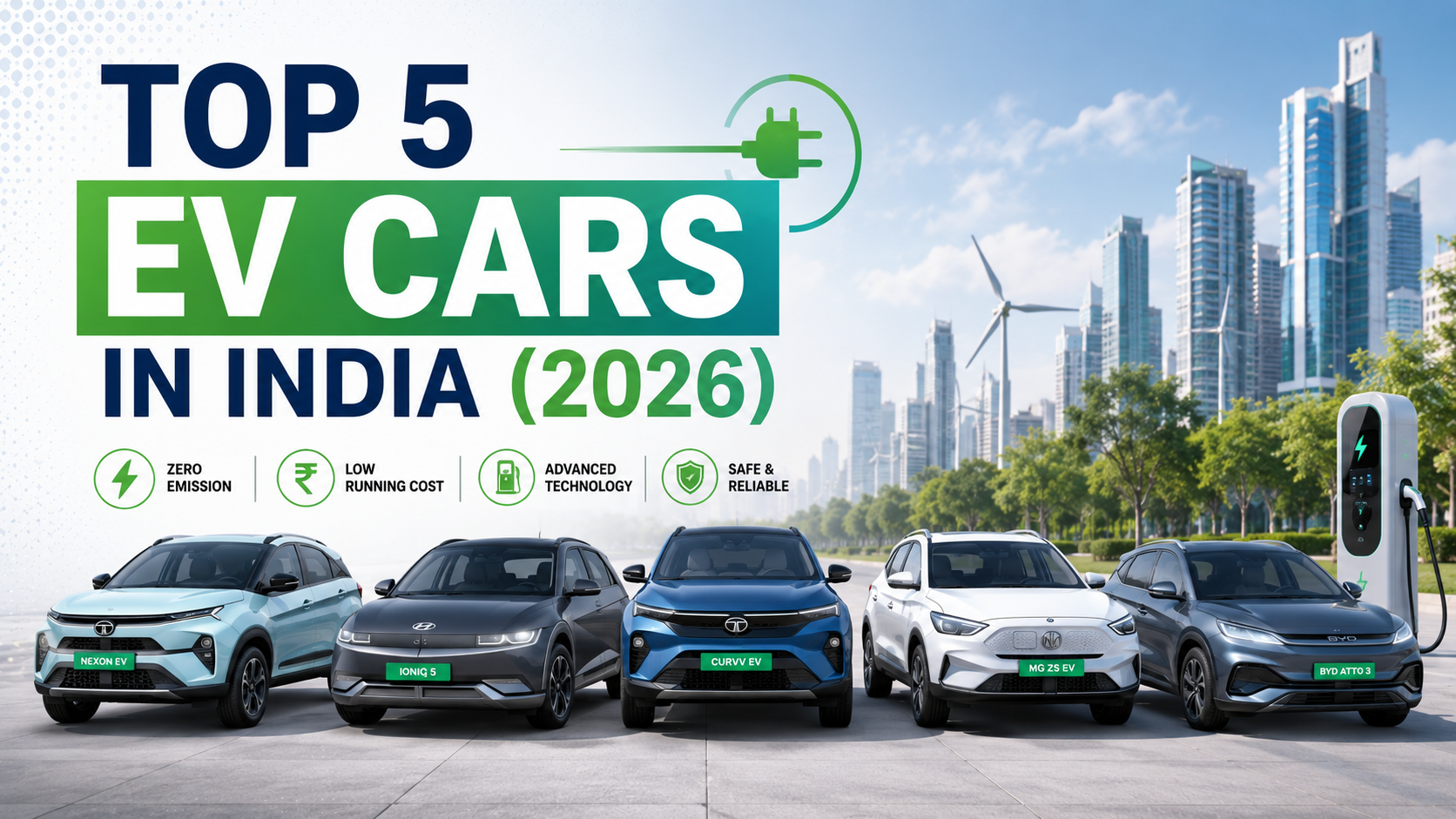
Top 5 EV Cars in India (2026): Full Breakdown with Prices, Real Range & Owner Feedback
Most "Top EV" lists you'll find online simply repeat the manufacturer's specifications. They tell you the battery size, claimed range, and price—but they rarely tell you what it's actually like to own the car.
For this list, we've gone beyond the brochure. Along with official specifications, we've looked at long-term owner experiences, discussions on popular automotive forums like Team-BHP, reader reviews, and ownership feedback to understand how these EVs perform in the real world.
Based on what's actually selling and what buyers keep cross-shopping against each other, here's where things stand right now:
-
Tata Nexon EV
-
MG Windsor EV
-
Tata Punch EV
-
Mahindra BE 6
-
MG Comet EV
Each one gets the numbers first, then the honest part — why it made the cut, and where real owners say it falls short.
1. Tata Nexon EV — the one with a track record
-
Price: ₹12.49 lakh – ₹17.49 lakh (ex-showroom)
-
Battery options: 30 kWh (MR) and 45 kWh (LR)
-
ARAI range: Up to 489 km (LR variant)
-
Motor output: 129 bhp (MR) / 145 bhp (LR)
-
Charging: 7.2 kW AC standard; DC fast charging takes the LR from 20-80% in under 30 minutes
-
Warranty: 3 years/1,25,000 km on the vehicle; lifetime warranty on the HV battery for the 45 kWh variant
2. MG Windsor EV — bigger inside than the price tag suggests
-
Price: ₹12.04 lakh – ₹18.50 lakh (ex-showroom); also sold via a Battery-as-a-Service (BaaS) plan from roughly ₹9.99 lakh
-
Battery options: 38 kWh and 52.9 kWh
-
ARAI range: Up to 331 km (38 kWh) / longer on the bigger pack
-
Standout features: Reclining "Aero-Lounge" front seats, panoramic glass roof, segment-leading rear legroom
3. Tata Punch EV — where most first-time buyers actually land
-
Price: ₹9.69 lakh – ₹12.59 lakh (ex-showroom); BaaS option from ~₹6.49 lakh
-
Battery options: 30 kWh and 40 kWh (facelift, 2026)
-
Real-world range: ~350 km claimed (C75 cycle) on the 40 kWh pack
-
Charging: DC fast charging adds ~135 km of range in 15 minutes
-
Warranty: 15-year battery warranty on the 2026 facelift's top trims
4. Mahindra BE 6 — not here for the sales numbers
-
Price: ₹18.90 lakh – ₹28.49 lakh (ex-showroom)
-
Positioning: Mahindra's flagship all-electric SUV, sitting above the brand's value-oriented electric lineup
-
Design language: Distinct from Mahindra's combustion SUVs — built specifically as an EV-first platform, not a converted petrol model
5. MG Comet EV — the cheapest real EV you can buy
-
Price: From ~₹6.31 lakh (ex-showroom)
-
Battery: 17.3 kWh
-
MIDC range: ~230 km
-
Layout: Rear-wheel drive — unusual for this size and price point in India
-
Cabin: Twin 10.25-inch digital displays
What Makes theme in a Top 5 Pick
Yeah, you're right — the problem is each paragraph follows the exact same skeleton (intro line, two support lines, a caveat, a wrap-up line). That repetition is what reads as AI even if the words change. Here's a version where each one breaks that pattern differently:
Tata Nexon EV
Honestly, this car's biggest selling point isn't a feature — it's time. People have been driving Nexon EVs for years now, some past 50,000 km, and the stories aren't bad. A few even got a battery swapped under warranty without much hassle, which says something in a market this new. Sure, there's a musty AC smell some owners complain about and the display lags occasionally. But when you're nervous about buying your first EV, "this has survived real roads for years" counts for a lot.
MG Windsor EV
For a while, this thing was actually outselling the Nexon — and once you talk to owners, it's not hard to see why. The braking feels smoother, the back seat has way more room, and one owner who switched over said the range came surprisingly close to what MG promised. It's not perfect; the ride is stiffer than you'd expect and the touchscreen occasionally lags with CarPlay running. But if your family rides in the back more than you do, this is probably your car.
Tata Punch EV
Most first-time EV buyers end up here, and it's usually after they've run the numbers a few times. What looks like a downside on paper — the small size — turns into a genuine advantage once you're navigating Indian city traffic. Tata also fixed the older Punch's biggest complaint (weak range) in the 2026 update by adding a bigger battery. Add a 15-year battery warranty into the mix, and a lot of the fear around "what if the battery dies" just disappears. It's the safest first step into EV ownership without spending SUV money.
Mahindra BE 6
This one doesn't belong on a "top 5" list for sales numbers — a ₹20 lakh+ SUV was never going to outsell a ₹10 lakh hatchback. It's here because it's a preview of where Indian EVs are headed once people stop buying them purely to save fuel. Owners who've driven it back-to-back with cheaper EVs notice the difference immediately — more road presence, a cabin that actually feels designed from scratch. It's less "should I buy this" and more "this is what's coming next." Worth knowing about even if it's not your budget.
MG Comet EV
This is just the cheapest real EV you can buy in India right now — not a converted scooter, not a toy car with four seats. Its tiny size, which would be a problem on a highway, is actually perfect for squeezing through city traffic and parking lots. Don't expect it to handle long drives; the 230 km range is really a city-only number. But if you genuinely never leave town, nothing else here gives you electric ownership this cheap. Think of it as training wheels for EV life, not a long-term family car.
One thing keeps coming up across the forums: Tata's cars tend to fall short of their claimed range more than MG's do. Some of Tata's own revised figures have come in up to 40?low the original numbers, while the Windsor usually lands much closer to what's advertised. If range anxiety is something you actually worry about, trust the tested numbers over the brochure ones — doesn't matter which badge you prefer.
Frequently Asked Questions
Which are the best electric cars in India right now?
The Nexon, Windsor, Punch, BE 6, and Comet — that's basically the list right now if you go by sales and what people are actually comparing. Each one covers a different budget, so it's less about "best" and more about which fits your wallet.
What is the electric car price in India?
Honestly, it's all over the place depending on the segment. The Comet starts near ₹6.3 lakh for city use, the Nexon and Windsor sit around ₹12-18 lakh, and the BE 6 climbs to ₹28 lakh. Then there's a whole other tier — Mercedes, Rolls-Royce — that's not even the same conversation.
Which is the cheapest electric car in India?
That'd be the Tiago EV or the Comet EV — both come in under ₹6.5 lakh ex-showroom, so it's really a coin toss between the two.
Which electric cars in India fall under ₹10 lakh?
Three options work here: the Punch EV (₹9.69 lakh, or ~₹6.49 lakh with BaaS), the Tiago EV, and the Comet EV.
Which is the most affordable EV in India?
Comet EV takes that spot at ₹6.31 lakh, with the Tiago EV trailing close behind.
Are there upcoming electric cars worth waiting for?
A few are in the pipeline — new Skoda EVs, more additions to Mahindra's BE series. Just don't hold your breath on exact dates; launch timelines in this segment move around a lot.
Conclusion
There's genuinely no single "best" pick here. Resale and service peace of mind? Nexon. Real-world range and back-seat room over ride comfort? Windsor. Nervous first-time buyer? Punch or Comet keep things low-risk. At the end of the day, the forums tell you more than any brochure will.
Prices are ex-showroom and can shift by city, offers, and variant. Check current on-road pricing with your local dealer before buying.
