
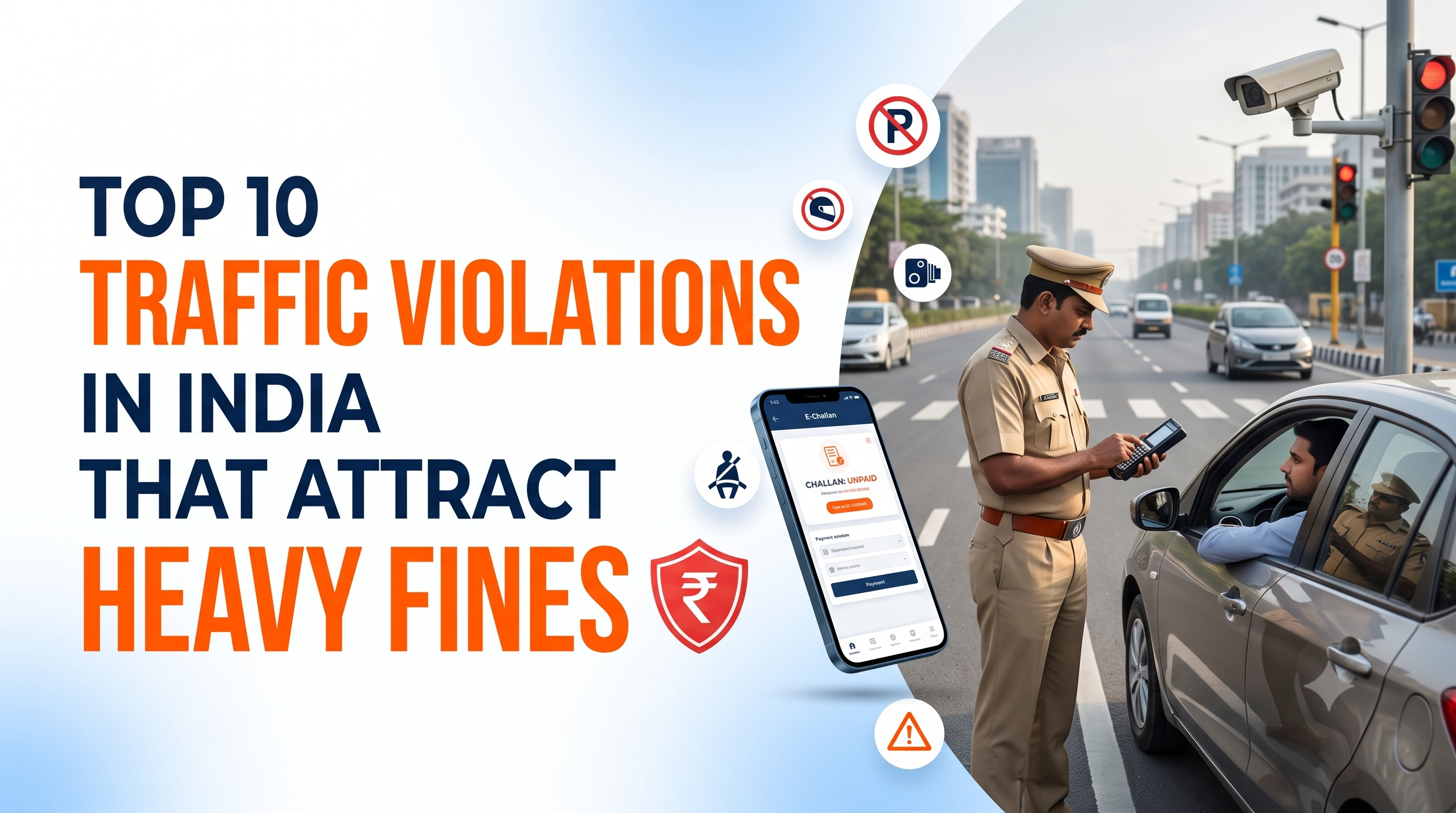
Top 10 Traffic Violations in India That Attract Heavy Fines
Traffic rules in India aren't what they used to be. Ever since the Motor Vehicles (Amendment) Act came into effect, penalties for common traffic offences have gone up sharply — in some cases, by more than 10x what they used to be. A lot of drivers are still going by old numbers in their head, which is exactly how people end up paying far more than they expected for something they assumed was a minor slip-up.
Here's a rundown of the traffic violations in India that currently carry the heaviest fines, what they'll actually cost you, and why these rules exist in the first place.
Here's a sharper, more original take — written to actually hook someone in, stay simple, but read like it knows what it's talking about.
Top 10 Traffic Violations in India That Cost Way More Than You Think
Quick question: do you actually know what fine you'd pay right now for not wearing a seatbelt? Most people guess somewhere between ₹100 and ₹500. The real number is ₹1,000 — and that's one of the cheaper fines on this list. Since the Motor Vehicles (Amendment) Act came in, the gap between what people think they'll pay and what they actually owe has gotten massive. Here's what's really on the line for the ten violations that cost the most.
1. No Licence, Driving Without a Valid Licence
Here's the thing about driving without a valid licence — it's not treated as a small slip. It's treated as proof you were never cleared to be on the road in the first place. The fine hits ₹5,000, and your vehicle can be taken away right there until a valid licence shows up. An expired licence and never having one at all? Same punishment, same outcome.
2. Drunk Driving Doesn't Stop at a Fine
This is the one violation on the list where money is the lesser concern. First offence: ₹10,000, or six months in jail — the court decides which. Second offence: ₹15,000, with jail time stretching to two years. The honest math here is simple — a cab costs less than either option, every single time.
3. Overspeeding
Overspeeding doesn't always feel dangerous in the moment, which is exactly why it causes more accidents than almost anything else on Indian roads. Light vehicles face fines between ₹1,000 and ₹2,000; heavier vehicles can be fined up to ₹4,000. Cross the line badly enough, and your licence gets suspended on top.
4. Riding Without a Helmet
The ₹1,000 fine for no helmet is just the visible part. What catches people off guard is the three-month licence suspension that comes with it — and the fact that in most states, your pillion rider is held to the exact same rule you are.
5. Skipping a Seatbelt
It's hard to find a rule this cheap to follow and this expensive to skip. ₹1,000 for the driver or front passenger not buckling up — and a growing number of states are now applying this to rear-seat passengers too. The "it's just a short drive" logic doesn't hold up anymore.
6. Using Your Phone While Driving
Phone use behind the wheel costs ₹5,000, and unlike most violations, you don't need an officer nearby to get caught — cameras handle this one automatically now. The logic behind the steep fine is blunt but fair: a few seconds of distraction is statistically all it takes for something to go badly wrong.
7. Jumping a Red Light
Jumping a signal can cost anywhere from ₹1,000 to ₹5,000, and with ANPR cameras now standard at most major intersections, the odds of getting away with it have dropped sharply. Do it more than once, and licence suspension enters the picture too.
8. Driving Without Insurance
Third-party insurance isn't a recommendation — it's the legal floor every vehicle needs to meet. Skip it, and you're fined ₹2,000 the first time, ₹4,000 the next, with the possibility of jail time stacked on top. It's also one of the easiest things to let lapse without noticing.
9. Overloading Is the One of the Heaviest Fines on the List
Most fines punish you after the fact. Overloading is different — the moment you're caught, the fine starts at ₹20,000, adds ₹2,000 per extra tonne, and the vehicle gets held until the excess weight comes off. It's less a penalty and more an on-the-spot correction.
10.Rash or Dangerous Driving
Aggressive lane-cutting, road rage, dangerous overtaking — a first offence costs ₹5,000, doubling to ₹10,000 if it happens again. But the real risk isn't the fine. If someone gets hurt because of it, the case stops being about traffic law entirely and becomes a criminal one.
FAQS
What's the single most expensive traffic fine in India?
Overloading a commercial vehicle tops the list, starting at ₹20,000 and climbing with every extra tonne. For private vehicles, drunk driving is the costliest at up to ₹15,000, plus possible jail time on repeat offences.
Why did fines like the helmet penalty go up so sharply?
Older fines were considered too low to actually change behaviour. The revised penalties under the Motor Vehicles (Amendment) Act were designed specifically to make safety violations feel costly enough to matter.
Are these fine amounts the same across every state?
Mostly, but not entirely. The Motor Vehicles Act sets the baseline, but individual states can adjust certain amounts — so it's worth checking your specific state's current rates.
Can I check a pending challan without visiting an RTO?
Yes. Entering your vehicle's RC number into an app like EasyMoney FX shows any pending fine instantly, with the option to pay it on the spot.
Do these rules apply the same way to bikes and cars?
Not entirely. Helmet rules are specific to two-wheelers, while seatbelt and insurance rules apply broadly across vehicle types — and the exact fine amount can shift slightly depending on the category.
Conclusion
Traffic fines in India have stopped being the kind of thing you can shrug off. With cameras catching violations in real time and digital systems flagging unpaid challans the moment they're issued, the gap between "I'll deal with it later" and "I should've known better" has gotten a lot smaller. Knowing the current numbers — not the ones from a few years back — is genuinely the cheapest way to stay out of trouble.
