
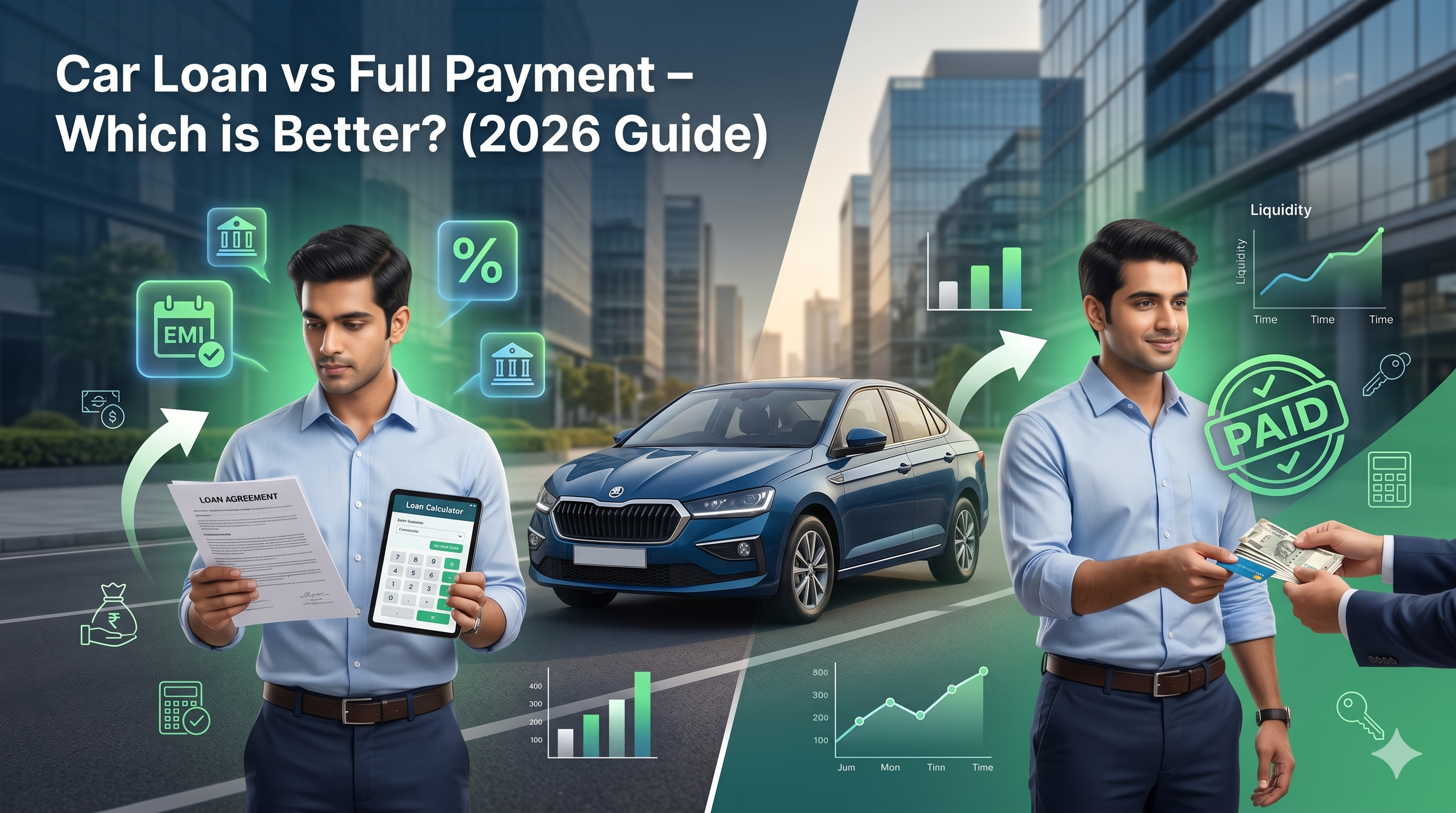
Car Loan vs Full Payment: Which is Better in India?
The real answer isn't about how much money you have — it's about how smartly you use it. We break down the numbers, the strategy, and the verdict.
Buying Car on Loan vs Cash in India — The Core Difference
Every year, lakhs of Indian car buyers wrestle with the same question: should I buy a car with full payment or take a loan? On the surface, it feels like a question about affordability. In reality, it's a question about financial strategy.
Both paths lead you to the same car. But they take your money on very different journeys.
Full Cash Payment
- Instant, complete ownership
- Zero ongoing EMI commitment
- No interest cost — ever
- Large lump sum leaves your savings
- Money locked in a depreciating asset
Car Loan (EMI)
- Ownership once loan is fully repaid
- Predictable monthly outflow
- Interest adds to total cost
- Remaining capital stays invested
- Builds your credit score over time
"It's not about whether you can afford the car. It's about whether your money works harder sitting in an investment — or sitting in your driveway."
EMI or Full Payment: Which is Better for Car? (Real Numbers)
The answer lies in a concept called opportunity cost — what your money could have earned had you invested it instead of paying for the car upfront.
Real-World Scenario: ₹10 Lakh Car in India
| ₹10L Car Price |
8.5% Loan Interest |
10–12% MF / FD Return |
|
₹2L Down Payment |
₹8L Loan Amount |
₹1.4L+ Extra Returns |
By investing ₹8 lakh instead of paying cash — even after accounting for loan interest — you can earn over ₹1.4 lakh in additional returns over the loan tenure. That's the opportunity cost advantage of choosing EMI wisely.
| Situation | Better Choice | Why | |
|---|---|---|---|
| Investment return > loan interest rate | EMI / Loan |
|
|
| Investment return < loan> | Cash | Paying interest loses you money net-net | |
| No stable income or high risk appetite | Cash |
|
|
| Need emergency liquidity buffer | EMI / Loan | Preserves cash for unexpected expenses | |
| Car used for business purposes | EMI / Loan | Interest qualifies for tax deduction |
Advantages of Buying Car with Cash in India — and Its Drawbacks
Cash payment is clean, simple, and psychologically satisfying. But it carries hidden costs that most buyers don't calculate.
Advantages of Cash |
Disadvantages of Cash |
|---|---|
|
|
|
|
|
|
|
|
|
|
|
|
Car Loan Advantages & Disadvantages in India
A car loan isn't just a debt instrument — used correctly, it's a financial leverage tool. Here's the complete picture:
Advantages of Cash |
Disadvantages of Cash |
|---|---|
|
|
|
|
|
|
|
|
|
|
|
|
Does a Car Loan Save Tax in India?
This is one of the most frequently searched questions — and the answer has an important caveat:
Tax Benefit: Business vs Personal Use
A) Business use vehicle:
Yes — the interest paid on a car loan used for business is deductible as a business expense under the Income Tax Act. Depreciation on the vehicle can also be claimed. Self-employed individuals and business owners benefit the most here.
B) Personal use vehicle:
No — there is no tax deduction available on car loan interest for a privately used vehicle. Unlike a home loan, a personal car loan offers zero Section 80C or any other income tax benefit for salaried individuals.
If you're a business owner or freelancer and the car will be used for client meetings, deliveries, or professional travel, documenting the business use can unlock meaningful tax savings. Consult a CA to structure this correctly.
Smart Decision Framework: How to Choose in 2026
Before signing a cheque or a loan agreement, run through this checklist honestly:
Ask Yourself These 5 Questions
1 Is my income stable enough to service an EMI for 3–7 years?
If your income is irregular, salaried with job uncertainty, or likely to dip, cash may be safer.
2Can I realistically earn more than 8.5–9% from investments?
If yes — through mutual funds, stocks, or business — EMI is the smarter mathematical choice.
3 Do I need this capital as an emergency buffer?
Locking all your savings into a car with no liquidity left is risky. A 6-month expense reserve should always exist.
4 Am I financially disciplined enough to actually invest the saved capital?
The EMI strategy only works if you invest the freed-up cash. If it'll get spent, cash payment may be wiser.
5 Is the car for personal or business use?
Business use unlocks tax deductions on loan interest — a significant advantage that can shift the calculus toward EMI.
Conclusion
There is no single right answer — but there is a right answer for you. If you have stable income, investment discipline, and returns exceeding loan rates, the EMI route builds more wealth. If you value simplicity, carry no investment habit, or have unstable income — cash is the cleaner choice.
- Cash = Safe, Simple, Zero Debt
- EMI = Strategic, Growth-Oriented
Frequently Asked Questions
Everything You've Searched For
Buy a car with full payment or on loan — which is best?
It depends on your financial situation. If your investment returns exceed the loan interest rate (currently 8.5–11% for car loans in India), taking a loan and investing the surplus is mathematically superior. If not — or if you value zero-debt peace of mind — full payment is the better choice.
Is EMI or full payment better for buying a car?
EMI is better when you can invest the remaining capital at a higher return than the loan rate. Full payment is better when you have no investment plan, have irregular income, or when interest rates are exceptionally high. Most financially disciplined buyers benefit from EMI.
Can we buy a car in cash in India?
Yes, it is legally permitted. However, cash transactions above ₹2 lakh are restricted under the Income Tax Act. Payments above this threshold must be made via cheque, NEFT, RTGS, or digital transfer. For a ₹10 lakh car, you cannot pay the full amount in physical cash.
Can we buy a car without a loan in India?
Absolutely. A car loan is entirely optional. You can purchase any vehicle outright using your own funds via cheque or bank transfer. Many buyers — especially retirees or those with accumulated savings — choose this route for its simplicity.
Can I buy a ₹10 lakh car in cash?
Not in physical currency. RBI regulations and Income Tax rules prohibit cash transactions above ₹2 lakh. To purchase a ₹10 lakh car "in cash" (meaning without a loan), you must pay via demand draft, RTGS, or online bank transfer. You may also need to furnish your PAN card for large transactions.
